Affiliate marketing is usually related to the use of websites, blogging, and SEO. But do you really need a website in order to make money through affiliate marketing? From my own experience, the answer is no.
There are many other ways to begin affiliate marketing without having a website. You can choose from different platforms, for example, YouTube, TikTok, Pinterest, social media, and email. The most important part will be selecting good products, making quality content, targeting the right people, and motivating people to visit your affiliate links.
In this article, I would like to tell you 7 ways to start affiliate marketing without a website.
What Is Affiliate Marketing?
Affiliate marketing is a type of commission income through the promotion of products or services offered by other companies.
For example, let’s say that you have created a YouTube video in which you explain how to select the best microphone for conducting online meetings. You make an affiliation and mention it in your description.
If your viewers follow your affiliation and purchase that microphone, then the company might pay you a commission.
Here is the simple process:
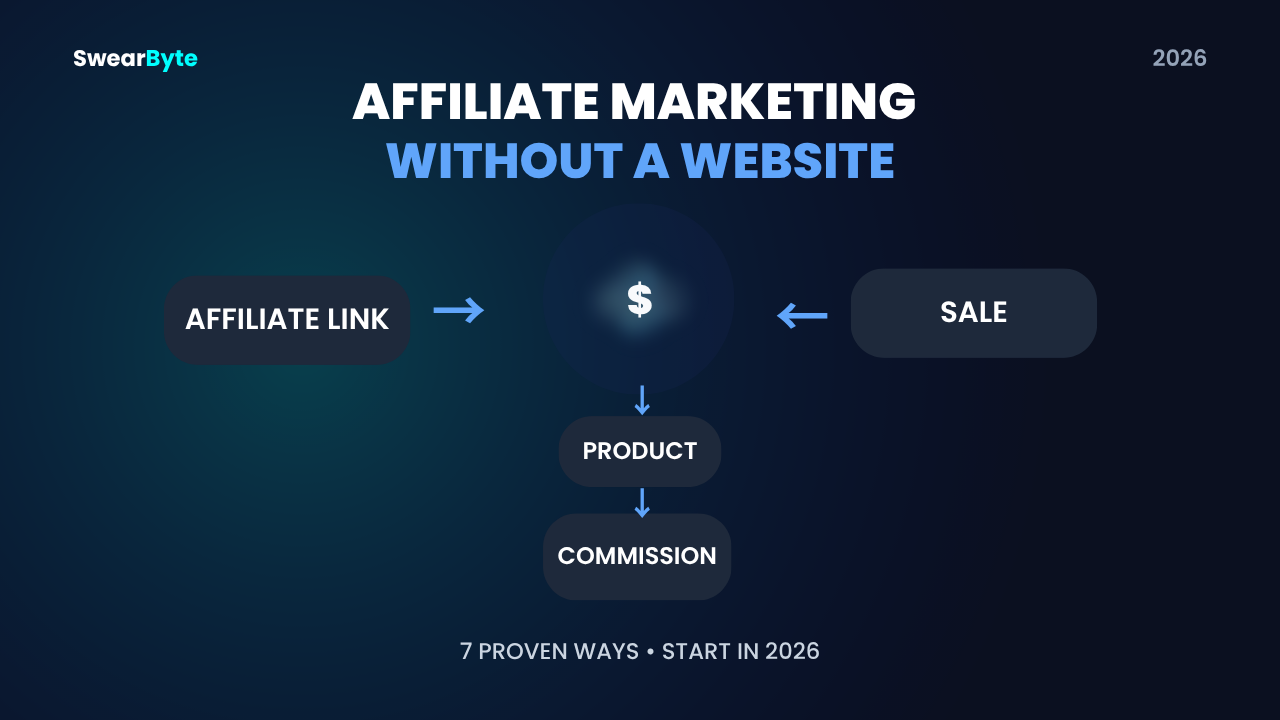
You → Create useful content → Recommend a product → Person clicks your affiliate link → Person purchases → You earn a commission
Creating the product and taking charge of its stock and distribution is not part of your responsibility, as you will only be involved in finding interested customers.
Nevertheless, affiliate marketing is not just about putting up links on the web; the success of affiliate marketers lies in building an audience and creating content for purchase decision-making.
Can You Do Affiliate Marketing Without a Website?
Yes, you can start affiliate marketing without a website.
It can be helpful in the case if you need to drive search traffic, but it is not a necessary thing. There are plenty of different ways to find people who are interested in your offer.
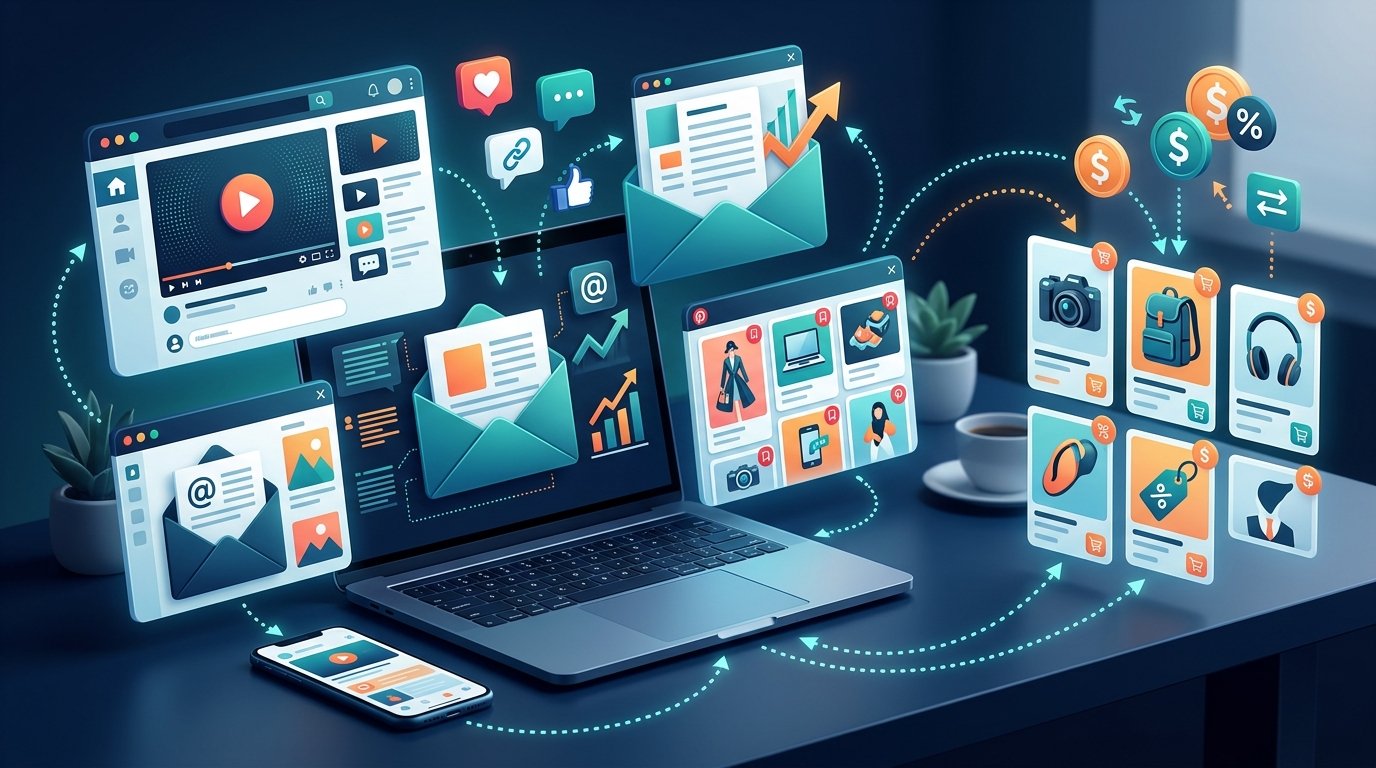
You can use platforms such as YouTube, TikTok, Pinterest, Instagram, Facebook, email lists, forums, and other types of communities.
For instance, someone interested in sports could create short videos for workouts and give suggestions about fitness products. Another person interested in gadgets could create product reviews and unboxings on YouTube. Moreover, one can use Pinterest and guide users to product recommendations.
A platform is simply the place where you can find your audience. It is your job to provide some useful content and direct your audience to certain products.
One thing should be noted here. You always need to read the affiliate program terms and rules, as well as the platform rules, before posting any affiliate links.
7 Ways to Do Affiliate Marketing Without a Website
1. Start a YouTube Channel
YouTube is one of the most powerful platforms for affiliate marketing without a website since individuals use YouTube when researching a product before they purchase it.
It does not mean that you have to have an expensive camera or studio. A smartphone, screen recorder, and some interesting ideas can be enough.
You may make videos like:
- Product reviews
- Comparisons between products
- Tutorials
- “Best products for…” videos
- Installation guides
- “How to” videos
- Demonstrations of software
For instance, instead of making a video like “My favorite keyboard,” you may make a more useful video such as “Best budget keyboards for working from home.”
This way, the person who searched this topic may be thinking about making a purchase already, which will make him/her more interested in affiliate marketing.
You may put affiliate links in the video description if it corresponds to the conditions of the affiliate program and YouTube’s terms.
Of course, you should state that you are using this affiliate link.
If your YouTube content includes paid promotions or other commercial relationships, check YouTube’s paid promotion guidelines before publishing.
The main error that people commit is making useless videos that are just advertisements. People do not want to hear one more sales speech; they want advice.
2. Use TikTok and Short-Form Videos
Another option for getting in contact with potential customers might be using short-form video platforms without having a website.
The problem is that you only have a short amount of time to capture the attention of your viewer. You need to tell your customer something useful fast enough.
For instance, when you are selling productivity software, you might make a short video where you demonstrate solving one of the problems with this software.
Instead of writing:
“Buy this productivity app.”
You can demonstrate:
“Here is how I organize five tasks in under one minute.”
This will give you something valuable for your viewer before asking him to do anything.
You can make product demos, tutorials, comparisons, tips, problem-solving videos, etc. Depending on the platform and affiliate program, you will be able to use either your profile link or other methods to redirect the traffic to your offer.
Do not think that any viral video will bring you some sales. The views are nice, but the relevant views are even better.
50,000 views from people who are not interested in your product may yield fewer sales than 5,000 views from people who are looking for your product.
3. Use Pinterest

Pinterest is one of those platforms that tends to be overlooked in discussions about affiliate marketing.
This platform is unique in terms of social networking compared to many other sites since users tend to look for ideas, products, guides, and inspiration quite often.
Some of the ideas for making pins would include:
“Best Accessories for Your Home Office”
“Essential Tools for College Students”
“Kitchen Products Worth Your Money”
“Apps That Increase Productivity”
It is essential to make useful and attractive content.
Pinterest allows users to build an audience and drive traffic to the site, where it is possible to use the affiliate links according to the affiliate program. Sometimes, depending on the rules of the affiliate program, you will be able to use either the affiliate links or create a content page.
Pinterest is best suited for visual niches, which include home improvement, fashion, food, travel, productivity, crafts, and lifestyle products.
Nevertheless, it is important to keep in mind that the platform should not be used to publish hundreds of low-quality promotional pins.
4. Build an Email Newsletter
Email newsletters may prove to be a good investment because you won’t be entirely relying on an algorithm.
To begin with, you can pick out a particular niche and have interested individuals subscribe to it.
These niches may include:
- AI tools
- Productivity
- Personal finances
- Tech deals
- Online education
- Fitness products
- Software recommendations
After people have subscribed, you can share useful information.
Assume that you have an email newsletter on the topic of productivity. In place of emailing something like “buy this software,” you can talk about the problem people face regarding productivity and give tips on how to fix it, and then suggest the tool that can do the job.
If that tool has an affiliate program and emails are allowed under their affiliate terms, you can add an affiliate link to your suggestion.
The most important thing with email marketing is trust. You won’t keep anyone reading your emails if every one of them ends up being a commercial.
First, share useful information, and then make your product recommendations
5. Use Social Media Content
Being an influencer is not an obligatory condition to run social media channels to promote affiliate links.
You may create a page dedicated to some particular theme and regularly post useful information on it.
In the case of the technology page, you may post the following articles:
“Top 3 Chrome extensions that will help you save time”
“Gadgets worth buying on a budget”
“Alternatives to expensive software that are absolutely free of charge”
“The best tools every remote worker should know”
And then suggest suitable products in relevant places.
The thing is that you need to choose a niche and not just blindly promote any products.
If you promote products on social media, it’s important to make any relevant brand or financial relationship clear to your audience. The FTC’s guide for social media influencers explains when and how disclosures should be made.
When you publish articles on headphones today, on cooking equipment tomorrow, and on fitness supplements the next day, it will be difficult for your audience to grasp the purpose of your channel.
If you’re interested in finding useful AI tools for everyday tasks, you can also check out our guide to AI tools that can make life easier.
Moreover, you need to comply with the commercial content regulations of the particular platform
6. Create Tutorials Around Products
Tutorial-type content is especially valuable for the affiliate industry since users who search for tutorials usually have some problem.
As in:
“How to set up a wireless microphone”
“How to create a budget spreadsheet”
“How to edit videos using your phone”
“How to sort files on Windows”
“How to make a quick presentation”
While solving a problem, you can naturally suggest a product.
The key phrase here is naturally.
Do not write a tutorial just for the sake of including an affiliate link. Write a useful tutorial and include a product suggestion whenever you need it.
This approach may also be applied in the software affiliate marketing niche. Showing a tutorial on how to use a certain program will attract those users who need it.
7. Participate in Online Communities
Online communities can also assist you in locating individuals interested in your niche.
Depending on the guidelines of the community, you may take part in discussions on Reddit, Facebook groups, forums, Q&A websites, and other relevant communities.
The idea is not to join a community and post affiliate links right away.
It is necessary to answer questions and become helpful.
For instance, if someone asks:
“Which microphone shall I purchase for video conferences?”
You can offer useful comparisons depending on their budget and needs. You can add affiliate links if they are acceptable in this particular community.
Affiliate spam is explicitly forbidden in many communities, so it is necessary to study their rules before posting anything promotional.
Communities should be regarded as places to earn credibility and not free advertising space.
How to Choose an Affiliate Program
Selecting the right affiliate program can be highly beneficial.
Do not opt for an affiliate program simply because it pays out the highest commissions.
Before enrolling in an affiliate program, think about the product itself, its commission rates, the method of payment, the cookie lifetime, reputation, and the policies of the affiliate program.
However, the most important question you have to ask yourself is:
Would I really recommend this product to someone who would value my advice?
If your answer is “no,” then move on.
Sometimes a product that pays out lower commissions can be better than a product paying out high commissions because it is in demand and has a great reputation.
Also, pay close attention to the affiliate program’s terms, as some programs prohibit certain types of advertising, paid traffic, brand bidding, email marketing, and direct linking.
What Products Should You Promote?
The products that should be promoted the most are those that are able to solve a real problem of your target audience.
For instance, if your target audience is a productivity audience, it will be interested in software, planners, note-taking apps, keyboards, monitors, etc.
If the audience is beginners in technology, then it can be interested in inexpensive accessories, software, online services, useful gadgets, etc.
It is possible to promote both physical and digital products.
Physical products usually provide a lower commission percentage but, nevertheless, have high consumer demand. In the case of digital products and software, there is a possibility to get a high commission or even recurring commission depending on the program.
Instead of asking yourself, “Which product pays the most?”
Try to ask:
“Which product is really useful for my target audience?”
How to Get Traffic Without a Website

Getting traffic is one of the major problems that you’ll face when doing affiliate marketing without having a website.
You could just focus on one particular platform instead of trying all of them at once.
For instance, you could concentrate on YouTube and post one helpful video each week.
You could also focus on making several short-form videos each week.
Another possibility would be Pinterest for a niche where images are more appropriate, as well as email once you have gathered some subscribers.
The worst mistake would be switching platforms all the time.
Allow yourself enough time to see if your content is working.
Focus on useful metrics like views, watch time, clicks, engagement, and conversions.
If people are watching your content, but nobody clicks, the problem may lie in your call to action or recommendation
How to Get Your First Affiliate Sale
Your first affiliate sale may take a while.
Firstly, decide on one specific niche and platform.
Secondly, select just a few products rather than signing up for tens of affiliate programs.
Develop content around real queries people have regarding these products.
For instance, when promoting some kind of software, do not write 20 articles praising it. Create tutorials, comparisons, use cases, etc.
The main thing to achieve at the very beginning is not earning hundreds of dollars.
What should your primary aim be?
It should be understanding of the entire process:
content -> audience -> click -> product page -> conversion.
Once you understand where people are dropping off, you can improve your strategy.
If you’re exploring different ways to earn online, you can also learn how to start freelancing with no experience and understand which beginner-friendly skills you can offer online
Common Affiliate Marketing Mistakes
One of the most frequent errors is offering too many products simultaneously.
The next mistake involves selecting products only based on their high commission rates.
Sometimes, inexperienced marketers share affiliate links without adding any helpful information.
This hardly creates any credibility.
Other errors involve ignoring platform rules, not disclosing affiliations, imitating others, using an incorrect audience, and quitting before gathering enough statistics.
Do not evaluate all your efforts based on one post or one video.
If you earn a commission from products you recommend, make your affiliate relationship clear to readers. The FTC’s Endorsement Guides explain that affiliate relationships should be disclosed clearly and conspicuously.
Affiliate marketing implies testing various topics, formats, products, and techniques.
Frequently Asked Questions
Can I begin affiliate marketing without a site?
Yes, you can use platforms like YouTube, TikTok, Pinterest, social networks, email, and many others, depending on affiliate program rules and platform policies.
Which platform should I choose for affiliate marketing without a website?
There is no platform that would suit everyone. YouTube can be used for review videos and tutorials, short-form videos for discovering a niche, Pinterest can be good for visually-oriented niches, and email marketing can also be used for building a direct audience.
Can beginners earn money from affiliate marketing?
Yes, beginners can earn affiliate commissions, but there is no guarantee of profits. Usually, it takes some time to build an audience, create useful content, and understand which products convert better.
How can I promote affiliate links without a website?
You can promote suitable products by means of methods approved by the affiliate program on YouTube, social networks, Pinterest, email, and any other platform.
Do I need to spend money to start affiliate marketing?
You can spend very little money to begin your promotion, using only free platforms and equipment that you already have. But in the future, you may have to invest in content creation and advertising.
Conclusion
Affiliate marketing without a website is a possible option to start in 2026. It turns out that the platform does not matter as much as the value of your content and the credibility you gain from it.
There is no need to delay until everything is set up perfectly. Simply choose a platform, choose a product that you honestly think will be helpful for people, and produce the first piece of content right now. Do not just learn affiliate marketing theory, but start implementing it.