A poor internet connection may turn ordinary tasks into trouble. Websites will take time to load, videos will keep buffering, download times will increase, and gaming may get interrupted. Prior to reaching out to your internet service provider or switching to another plan, there are some steps you may consider taking before that.
The good thing about the issue of how to make your internet faster is that it may have nothing to do with upgrading your technology or plan. Some elements, such as improper router location, too many devices connected to the network, poor Wi-Fi signal, old equipment, or necessary bandwidth use, may affect your internet speed.
Here are 10 methods to increase your internet speed.
1. Run an Internet Speed Test First
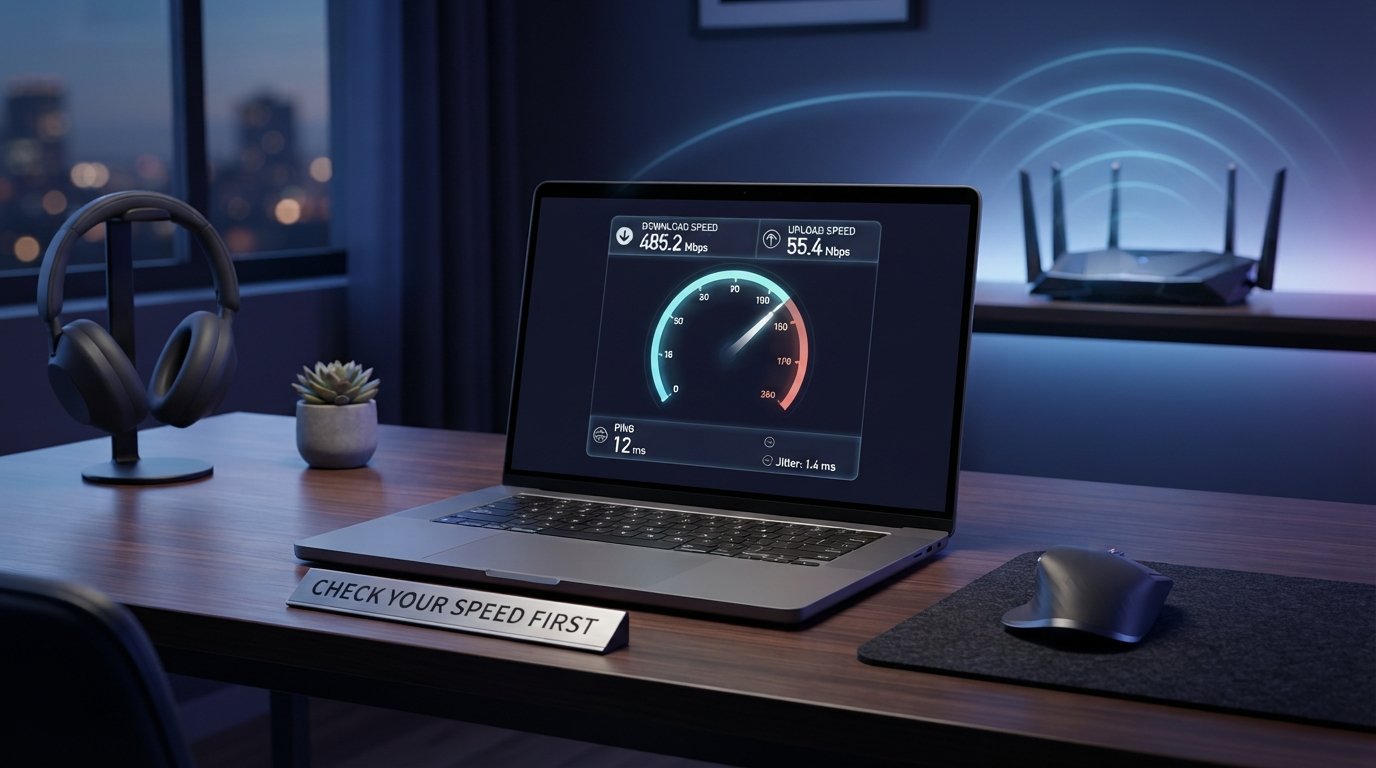
Find out the actual speed of your connection before doing anything else.
The speed test will give you an idea about your downloading speed, uploading speed, and even ping if it’s available. You should then compare the speed with the one that your internet service provider is offering you. Use Speedtest by Ookla to test your internet connection speed. Compare it to the speed that you are paying for with your internet service provider.
For example, when your internet service provider guarantees you 100 Mbps but your actual speed turns out to be something around 20 Mbps, there’s an issue you need to address.
Check Both Wi-Fi and Ethernet
If you are able to obtain an Ethernet cable, try connecting your computer directly to the router and perform a speed test once again.
If the Ethernet connection turns out to be noticeably faster than the Wi-Fi connection, then most probably your internet connection is working just fine. It means that there is some problem with your Wi-Fi connection.
This will help you avoid unnecessary actions.
2. Restart Your Router and Modem
It may sound a little bit too simplistic, but you should try restarting your networking hardware. Routers and modems can encounter software issues, congested lines, or temporary communication troubles with your internet provider.
How to Reboot Your Equipment Correctly
You should not just turn off the router and then power it back on straight away.
But:
- Switch off the router.
- If you have an extra modem or ONT, switch that off too.
- Count to 30 or wait for about 30 seconds.
- Power up the modem/ONT first.
- Wait until the connection lights stabilize.
- Power up the router.
- Wait for your gadgets to connect.
Finally, perform another speed test.
If your Internet connection works better at some point and gets back to normal later, there might be a more serious problem with your connection.
3. Move Your Router to a Better Location
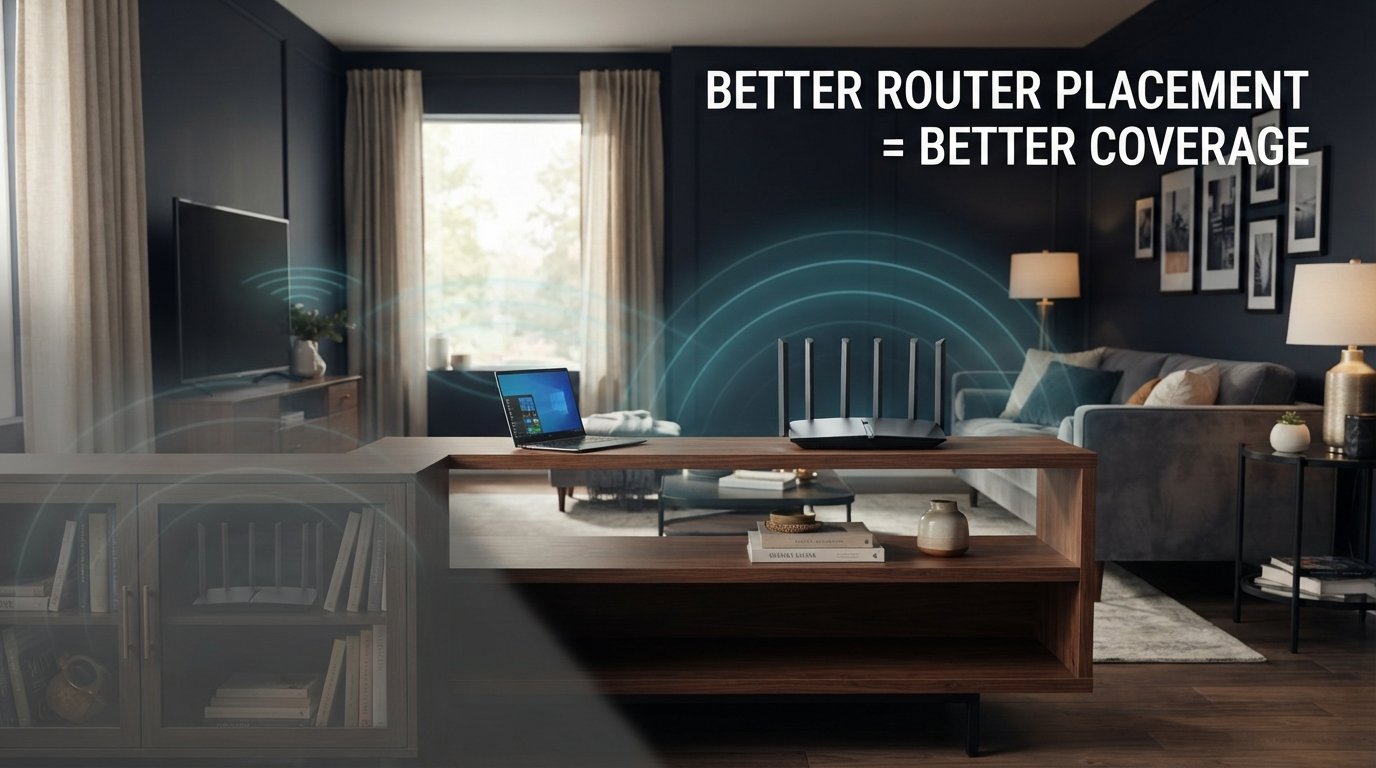
The positioning of your router can significantly affect Wi-Fi performance.
If your router is located inside a cabinet, behind a TV set, or at the corner of a room on the floor, the Wi-Fi signal may be inefficiently transmitted to the device.
To have efficient coverage, place your router:
- In a centralized position
- On a raised plane
- Not near a wall made of thick material
- Not near a large metallic object
- Not near an appliance that creates interference
- Not in furniture
Do Not Block the Router With Anything
Wi-Fi signals diminish when they come into contact with walls or other physical barriers. Concrete walls are particularly hard on Wi-Fi signals.
In a situation where you have your router installed at one end of the house while using your computer at the other end, it might help to move your router to the middle of your house.
Remember that purchasing an internet package that promises higher speeds will not necessarily give you a stronger Wi-Fi signal. Your ISP will give you the maximum speed available only at your router.
4. Disconnect Devices You Don’t Need
Every device that is connected to your network can consume your bandwidth.
Your phones, laptops, smart televisions, tablets, gaming consoles, cameras, streaming boxes, and even home appliances can communicate through the internet without you knowing about it.
When you are browsing, you won’t have any problems, but when several devices do heavy lifting at once, it may affect your bandwidth.
Bandwidth-Consuming Operations
Specifically,
- Streaming 4K videos
- Big downloads
- Backups in the cloud
- Game patches
- Uploading videos
- BitTorrent
- Several video conferences
- Uploads from security cameras
For example, if one of the users in your household is downloading a game worth 100 GB while at the same time another user is streaming high-quality videos, the speed of your internet usage could be considerably slowed down.
Turn off your devices or suspend bandwidth-consuming operations.
5. Stop Background Downloads and Updates
The most frequent cause of a sudden slowdown in your Internet connection is something that is being downloaded to your computer in the background.
There could be an update installation, file sync, game download, or image upload going on in the background.
Check Your Computer for Network Usage
In Windows, you can use Task Manager to see what applications are utilizing network connections.
Press:
Ctrl + Shift + Esc
Then see which applications are having significant network activity.
In addition, depending on the Windows version you have, you can also use Windows’ network settings to find out about your data utilization.
You need to monitor these kinds of applications:
- Cloud Storage
- Game Launcher
- Update Software
- Backup Software
- Video Editing Software
- File Sharing
- Browser Downloads
If anything is taking up your bandwidth, then pause it for testing purposes.
If you have a computer running on the Windows operating system and suspect that your computer is causing the slowdown, the article on how to make Windows 11 faster is an informative resource.
6. Use the Right Wi-Fi Band
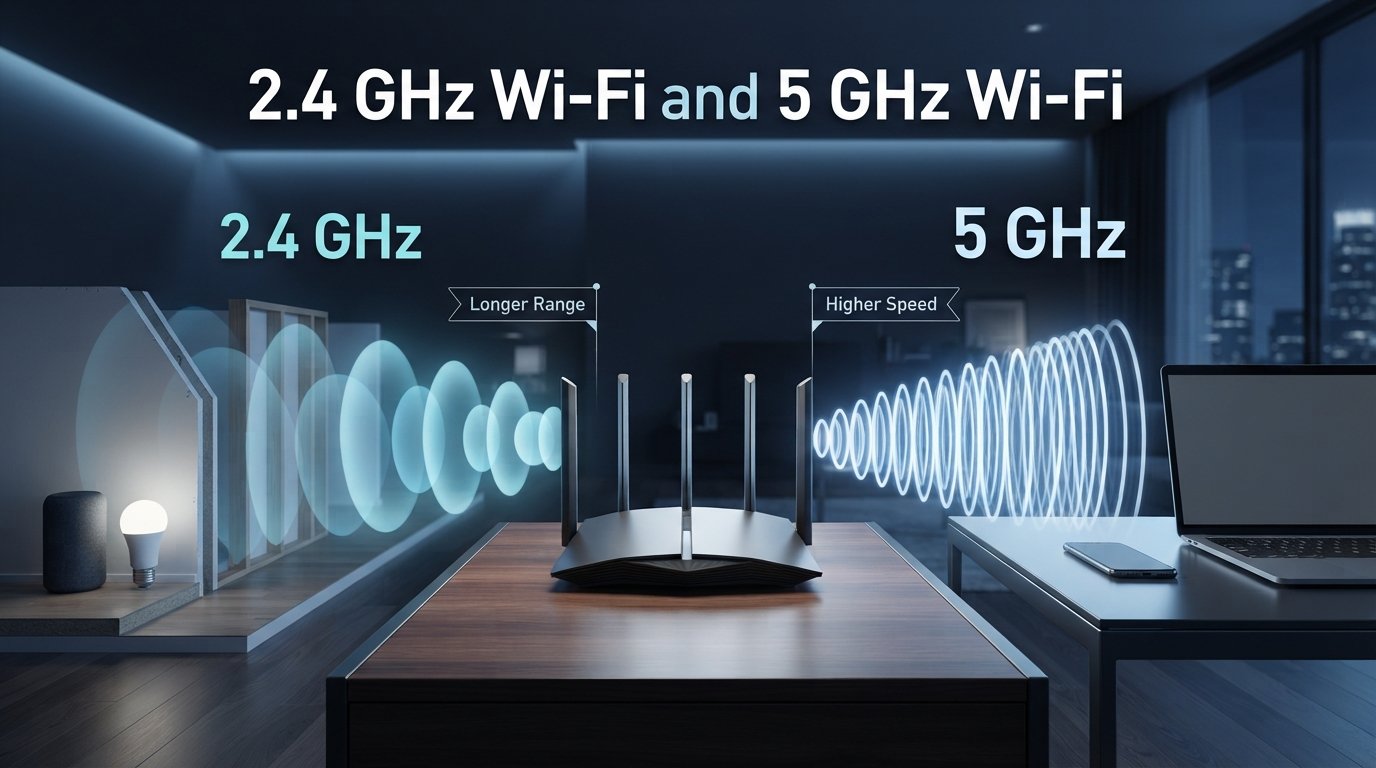
Most modern routers give users multiple options for Wi-Fi bands, including 2.4 GHz and 5 GHz.
Making the right choice may have a certain impact on your performance.
Wi-Fi 2.4 GHz and 5 GHz
Wi-Fi 2.4 GHz has a better range and can easily pass obstacles but is more crowded and gives lower maximum speeds compared to 5 GHz.
Wi-Fi 5 GHz has faster speeds but is less stable at long ranges; thus, it works best when used from a distance of no more than a few meters from the router.
If your device is capable of using 5 GHz and is close to the router, then using 5 GHz will be the right choice.
Yet, it is not always the best choice, especially in situations where the user is far away from the router, or there are several walls between them.
When to Use Each Band
Choose 5 GHz when:
- You are close to the router
- You require faster speeds
- You stream HD videos
- You download large files
- You want low wireless interference
Choose 2.4 GHz when:
- You are far away from the router
- There are many walls in between you and the router
- You require long range
- Your device does not support 5 GHz frequencies
If you have an advanced router, the new Wi-Fi technology can also give improved performance to your wireless connection.
7. Reduce Wi-Fi Interference

Even if your internet connection speed is good, you may experience some degradation due to wireless interference.
Wireless interference may come from nearby Wi-Fi networks, Bluetooth gadgets, electronics, and even obstructions between the router and receiver.
It becomes especially relevant in apartments and highly congested places with lots of routers around.
Changing Wi-Fi Channel
Most contemporary routers are designed to choose an appropriate wireless channel, although there may be situations when a manual change is needed.
When it comes to 2.4 GHz networks, the channels that are usually used are 1, 6, and 11, as they do not interfere with one another, unlike the majority of channels.
As far as 5 GHz networks are concerned, everything depends on your router and your region.
If your router has an option for automatic channel selection, you can start with it. If not, you can examine the settings of your router.
Do Not Modify Settings Randomly
Routers have plenty of technical settings available to users. Modifying settings without knowing what they do may even impair your network’s performance.
When in doubt about a particular setting, consult your router’s manual.
8. Update Your Router’s Firmware
Your router, in fact, is a small computer that runs on its own firmware program.
Firmware updates are made by manufacturers to address any bugs and increase the overall security level, and at times, stability/performance issues.
If your router hasn’t been updated for a while, see if there is an updated firmware available.
Why You Should Update Your Router
An outdated router may have problems with:
- Stability
- Security
- Compatibility
- Wireless performance
- Random disconnections
While some routers update themselves, others will need you to check the administration interface for updates manually.
Remember to always read the manual before updating your router. Never turn off your router during firmware installation.
9. Check Your DNS Settings
The domain name system, or DNS for short, is used to convert domain names into IP addresses.
When entering a website address in your browser, DNS helps your device find out where this website is located on the Internet.
Switching the DNS servers might help make websites load faster, especially if your current DNS is slow or inefficient.
But using a different DNS will not increase the speed of your internet connection.
When Changing DNS Can Work
You may experience improvements when encountering the following issues:
- Website addresses resolving slowly
- Periodic DNS errors
- Some websites are taking too much time to start loading
- ISP DNS servers being unreliable
There are several popular public DNS providers, such as those by companies like Google and Cloudflare. In case you wish to get familiar with Cloudflare’s 1.1.1.1 DNS resolver, you can consult their official documentation before configuring your DNS settings.
Cloudflare 1.1.1.1 DNS documentation
Before switching DNS servers, it is recommended to write down your current configuration in case you need to change it back.
Also keep in mind that the performance of a DNS server depends on your location and internet provider.
10. Use Ethernet for Speed-Critical Devices
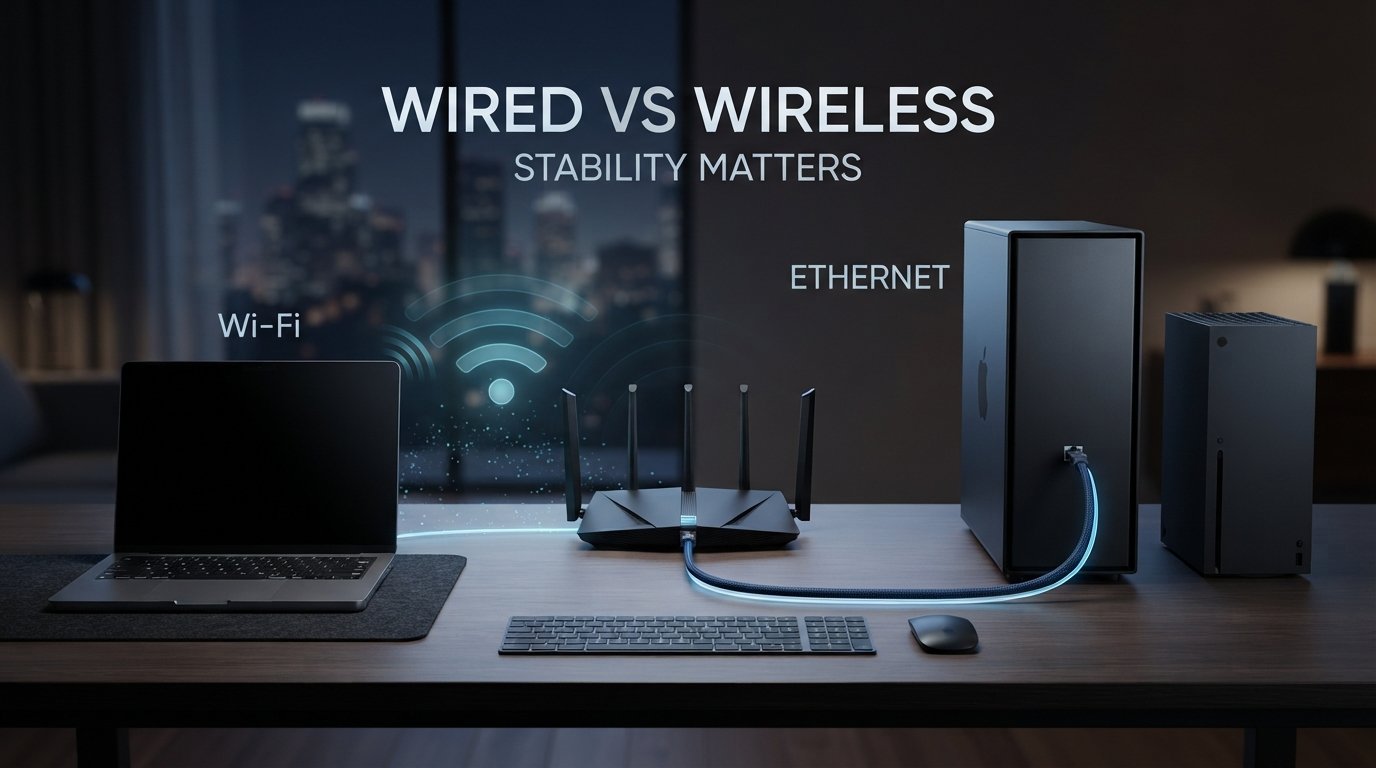
Ethernet connection can provide you with maximum stability.
With a wired connection, you don’t have to worry about interference, signal loss, network congestion, or physical barriers, which may hinder your Wi-Fi connection.
For some devices, Ethernet may be considered as follows:
- Desktop computer
- Game console
- Smart TV
- Media streaming box
- Workstation
- Network storage
Why Ethernet Can Be Better
A wired connection could offer you:
- Faster speeds
- Less latency
- More reliability
- No interference
- Reliable connectivity for big downloads
It is not necessary to connect all devices via Ethernet cable.
Connect wired devices that require reliable connectivity and keep smartphones, tablets, etc., on Wi-Fi.
What If Your Internet Is Still Slow?
If you have tried all ten steps and your internet connection is still slow, then it is time to figure out whether the problem is in your house or from the Internet Service Provider.
The first step would be to test the connection with Ethernet.
If the speed with Ethernet is also considerably lower than what you are paying for, then check your modem, ONT, cables, or ISP connection.
If you are using Windows and the issue seems to be with Wi-Fi and not the internet service provider, Microsoft’s guide on troubleshooting Wi-Fi should be helpful.
Microsoft’s Wi-Fi troubleshooting guide
Check Your Network Equipment
Check your modem or router for warning signs or abnormal activity.
This may include checking:
- Ethernet cables
- Power connections
- Router temperature
- Router age
- Firmware version
- Connection logs, if possible
A damaged Ethernet cable and outdated network equipment can cause similar troubles with the speed of the Internet.
Contact Your Internet Provider
If your wired speed continues to fall short of the expected value, you should get in touch with your ISP.
However, before doing that, make sure to take a couple of speed tests.
Let them know of:
- The speed of the package that you have subscribed to
- The download speed that you are getting
- The upload speed that you are getting
- If the test was conducted via Ethernet
- The time when the issue happens
- If there are other devices connected as well
How to Make Your Internet Faster on a Phone
If your phone is where you’re encountering slow internet, then first figure out whether you are using Wi-Fi or mobile internet.
For Wi-Fi:
- Go closer to the router.
- Disconnect and reconnect the connection.
- Reboot your phone.
- Reboot the router.
- Forget the Wi-Fi network and reconnect again.
- See if other devices are facing the same problem.
- Try another Wi-Fi network, if possible.
If other devices have good speed while your phone is still slow, then the problem lies in the phone itself or in the settings of the network.
Mobile internet depends on a lot of factors.
When Should You Upgrade Your Internet Plan?
All slow connections do not necessarily mean upgrades are required.
In situations where your connection has been consistently performing at its expected speeds but is being used by several people to perform high-speed activities, then your household may just require a higher bandwidth.
A better connection will be necessary in cases where:
- Several people are streaming at once.
- Many devices are constantly downloading heavy files.
- You are often uploading heavy videos.
- Your household has many simultaneous users.
- You cannot meet your usual needs with your current package.
But first, test out your current connection.
It does not make much sense for you to pay for a much faster connection than what you actually require.
Common Mistakes That Can Make Internet Troubleshooting Worse
If you wish to solve your problem with slow internet, you should not try changing multiple things at once.
If you change your DNS, channels for your router, Wi-Fi configuration, and your network adapter at the same time, you will not be able to tell which adjustment made any difference.
It is better to start with changing one thing at a time and checking whether it improved your situation.
Do not install any internet boosters as well—most of them do not really help to speed up the process and just add some extra software to your system.
Frequently Asked Questions
Is it possible to boost my internet speed without upgrading my package?
Sure. Adjusting the router positioning, minimizing congestion on the network, using Ethernet, avoiding background downloads, and addressing the issue of Wi-Fi interference can help enhance your browsing experience.
Why is my internet slow despite the results of a speed test?
The speed test is designed to measure certain factors of your internet performance. However, you may face other obstacles such as a weak Wi-Fi signal, delayed DNS lookup, poor site performance, browser problems, latency, and others.
Will restarting the router boost my internet speed?
Restarting helps solve temporary connection and software issues but does not provide any permanent boost for the speed offered by the ISP.
Is 5 GHz Wi-Fi faster than 2.4 GHz?
While 5 GHz is able to offer greater speed and lower congestion at shorter ranges, 2.4 GHz usually offers improved range.
Will changing DNS make my internet faster?
Changing DNS may help to make sites start loading faster, but it won’t increase your internet speed itself.
Why is Wi-Fi slower than Ethernet?
Wi-Fi is subject to a number of conditions such as distance, walls, interference, congestion, and hardware. On the other hand, Ethernet provides you with a wired connection.
How do I improve my internet for gaming?
Use Ethernet whenever it’s possible, limit bandwidth-consuming traffic on your network, boost your Wi-Fi performance, and pay attention to your latency and overall connection stability, not just to your download speed.
Do I need to buy a new router?
It depends on why your internet speed is slow. You have to make sure that the router is the main cause of slow internet.
Conclusion
Understanding how to make your internet faster requires pinpointing the exact cause.
Never jump straight into believing you require an upgraded internet package. There are some basic things you can do, such as doing a few speed tests, restarting the router, optimizing its position, minimizing activities on the network, and comparing speeds between Wi-Fi and Ethernet.
Depending on whether it is a problem with your Wi-Fi signal range, moving the router around or using Ethernet can have more impact than switching packages. However, if your hardline connection is noticeably slower than the package you are paying for, then you should definitely contact the provider.
The most crucial part of this process involves troubleshooting your issue methodically and focusing on the root of the problem rather than employing general “internet booster” hacks.